Open Call – Chaski Magazine 2026 Edition
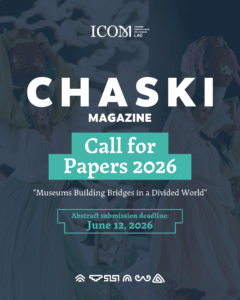
Chaski, a word that in the Quechua language means messenger, is a magazine founded in 1985 with the aim of promoting and disseminating the work and activities of Latin American museums and their specialists. Since its inception as a project of the then ICOM Secretariat for Latin America and the Caribbean —now the ICOM LAC Regional Alliance—, the magazine has been a sustained effort to bring visibility to museum activity in the region. Over time, it has evolved to establish itself as an annual digital publication since 2022.
In this framework, Chaski magazine invites the museological community to participate in its 2026 edition. Proposals for articles are welcome, including reflections, experiences, case studies, research, or debates related to the field of museums and cultural heritage, focusing on the central theme:
“Museums building bridges in a divided world”
At the beginning of 2026, the British Museum removed the reference to “Palestine” from several labels and maps in its exhibitions on the ancient Middle East, particularly in sections on the ancient Levant and Egypt, arguing that the use of the term was anachronistic, inaccurate, and politically non-neutral to describe the region between 1700 and 1500 BC. All of this takes place in a context of humanitarian, political, ethical, and military conflict in the Palestinian territories affected by the Israeli occupation, where both museums and other expressions of local heritage have been reduced to rubble.
Meanwhile, the recent gala of the Metropolitan Museum of Art (MET) in New York has been described as the most controversial in the history of this event, where the participation of highly recognized billionaires was criticized due to accusations of labor abuse, political interference, and support for the U.S. Immigration and Customs Enforcement (ICE)—an agency responsible for the persecution, imprisonment, and deportation of Latino migrants, as well as the assassination of American activists.
These are two examples where the involvement of museums is central, particularly regarding complex issues in these turbulent times and within a framework of major controversies that exacerbate divisions on various fronts. The divided world also lives in our streets, museums, and memories. Therefore, we call for the construction of bridges from the territories, struggles, and knowledge of Latin America and the Caribbean.
From this broad framework of events, we ask ourselves: Are museums an Overton Window, adapting their discursive frameworks —ethical, inclusive, moral, etc.— according to a moldable public opinion that shifts between the politically acceptable and the flatly unacceptable, or are they lighthouses and guides for major civilizational pillars such as the promotion of and respect for social, political, economic, environmental, and human rights?
In a present marked by inequalities felt in the territories and the daily lives of our communities, the museums of our region are not only challenged but called upon to rethink their role and place within this scenario. In alignment with the motto “Museums uniting a divided world” and the proposal of Chaski 2026, this edition invites us to view LAC museums as spaces capable of weaving bridges, acting as mediators between diverse memories, knowledge, and experiences, creating room for listening, dialogue, and collective construction from critical and decolonial perspectives that promote the protection of the planet and its environment, the active and democratic participation of communities, the use of tools that foster network building, and the defense of Peace.
In light of these examples from outside our region, we encourage authors from Latin America and the Caribbean to present case studies and experiences based on the following themes:
-
Museums, communities, networks, and alliances: Links with territories, community participation and work, collaboration between museums and institutions.
-
Education and mediation: Educational strategies, accessibility, and audience building.
-
Digital transformation: Use of technologies to expand access and participation.
-
Memories, narratives, experience, and affectivity: Narratives in tension, inclusion of diverse voices and decolonial approaches, the museum as a space for encounter, care, and the construction of meaning.
-
Museums and the future: sustainability, environment, and social justice: The social role of museums in the face of contemporary challenges.
Interested individuals must submit an abstract of their proposal with a maximum length of 300 words, clearly stating the topic, approach, objectives, and main contributions of the article. The abstract may be submitted in Spanish, English or Portuguese, and must clarify which of the 5 themes it aligns with.
-
Deadline for abstract submission: June 12, 2026
-
Submission email: revistachaski.icomlac@gmail.com
Abstracts will be reviewed by the Editorial Committee. One article will be selected for each of the 5 themes. Selected proposals will be notified no later than June 22 and will be invited to develop the full article. In that case, the texts must not exceed 1,500 words and must be delivered before July 24.
For any additional inquiries, please do not hesitate to contact us via the provided email. We look forward to your contributions to continue strengthening the exchange of knowledge and experiences in the museum field.
Sincerely,
Leonardo Mellado, Editor of Chaski
More information about Chaski and previous editions: revistachaski-icomlac.com
More information about ICOM LAC: https://icom-lac.mini.icom.museum/